Guide
Plan your day out loud in two minutes
Each morning, answer four questions out loud: what would make today good, what the first small step is, when you will start it, and what else has to happen. Keep the result to three things or fewer and put it somewhere you will see all day. It takes about two minutes.
The four questions
- What would make today a good day? One outcome. If you name three, pick the one you would be most annoyed to miss.
- What is the first small step? Something you could start in the next ten minutes: open the draft, write the test name, reply to one email.
- When and where will you start it? A time or a cue you already have: "at 9:30", or "after standup, at my desk".
- What else has to happen today? At most two more items. Anything beyond that goes on a later list.
Saying it out loud forces short answers, because rambling sounds like rambling. If you live alone, talk to the room. If you share an office, mutter, or type the same four answers.
What the research supports
Two findings carry most of the weight, and both are about the plan rather than the voice.
| Finding | What it means for the routine | Source |
|---|---|---|
| If-then plans ("when X happens, I will do Y") help people reach goals: d = 0.65 across 94 tests, and between 0.27 and 0.66 across 642 tests, larger with if-then wording | Question 3 turns "write the report" into "after standup, I open the report draft" | Gollwitzer & Sheeran 2006; Sheeran, Listrom & Gollwitzer 2025 |
| Planning helped people reach one goal but stopped helping when they planned several at once | Keep the list short. "Fewer is better" is the finding; three is a practical ceiling | Dalton & Spiller 2012; Verhoeven et al. 2013 |
| Making a specific plan for an unfinished goal reduced how often it intruded on other work | Writing down "what else has to happen" lets you stop rehearsing it | Masicampo & Baumeister 2011 |
| People underestimate how long tasks take, and breaking a task into parts reduces the bias | Question 2 asks for a first step, which is the start of that breakdown | Buehler, Griffin & Ross 1994; Kruger & Evans 2004 |
Two limits are worth knowing. We found no study comparing spoken plans with written ones, so the case for speaking is that it is quick and hard to over-elaborate. And reviews of time-management practice find it relates more to wellbeing than to measured performance (Aeon, Faber & Panaccio 2021). Expect a calmer day before you expect a more productive one.
Ways to do it on a Mac
- Paper or a sticky note. Still the fastest. Keep it beside the keyboard so the list stays in view.
- Apple Notes with dictation. Turn on Dictation in System Settings → Keyboard, then choose Edit → Start Dictation and speak your four answers into a note pinned to the top of the list.
- A calendar block. Put the first step in your calendar at the time you named. The calendar alert becomes the "when".
- Notchbird. It asks the questions for you each morning and puts the answers in the notch, described below.
How Notchbird runs the routine
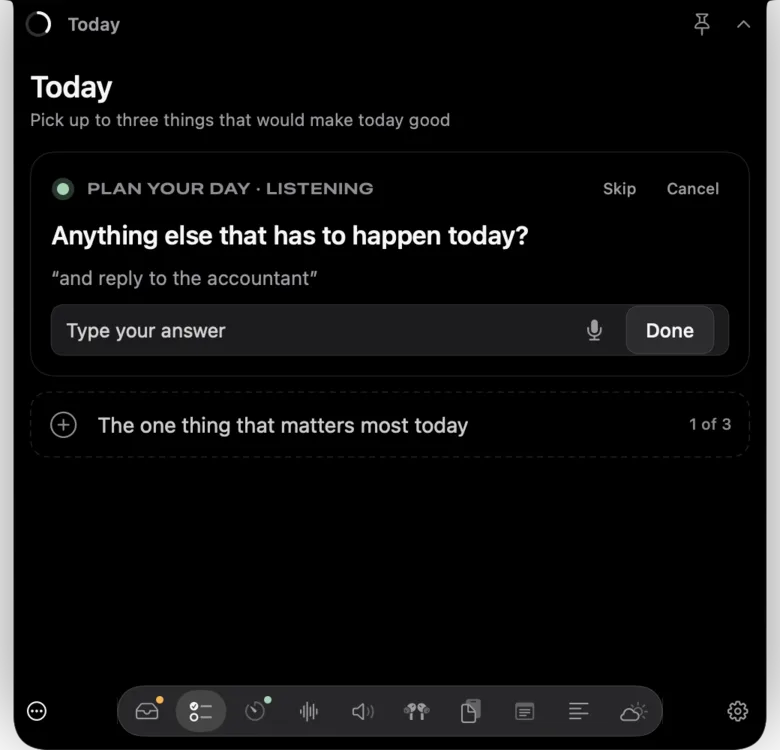
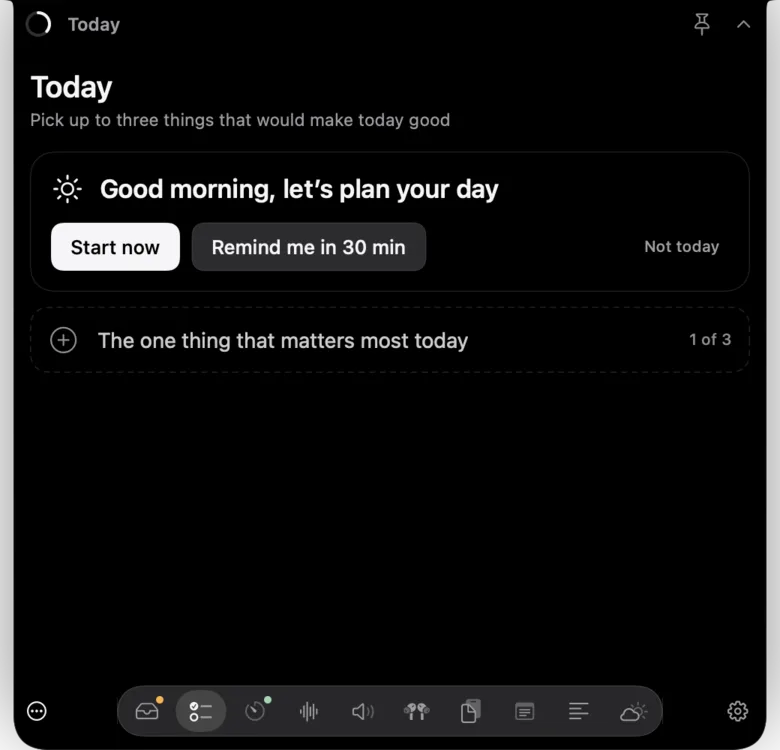
The first time you sit down each morning, Notchbird opens a card in the notch: Good morning, let's plan your day. Choose Start now and it asks what would make today good, what the first small step is, and what else has to happen. You answer out loud. Speech is transcribed on your Mac, and nothing is saved until you confirm.
It then reads the plan back. Say yes and your three things appear in Today, with the first step marked Now, so a glance at the notch tells you what you are meant to be doing. Notchbird skips the interview during a call, while you share your screen, and once your day is planned. You can change the time or turn it off in Settings → Features → Plan my day.
In the evening, Today asks what should come back tomorrow and lets the rest go. Planning when and how you will finish an incomplete task has been linked to switching off better in the evening (Smit 2016).
Three ways the routine fails
- The list grows. Seven items is a backlog. Move the extras somewhere else.
- The first step is a project. "Finish the pitch deck" is an outcome. "Write the title slide" is a step.
- No time attached. Without a when, the plan has nothing to trigger it. "After coffee" counts.
Related: run the first step as a focus session, add steady background noise, or see every guide.
Sources
- Gollwitzer & Sheeran (2006), implementation intentions and goal achievement
- Sheeran, Listrom & Gollwitzer (2025), the when and how of planning
- Dalton & Spiller (2012), too much of a good thing
- Verhoeven et al. (2013), multiple implementation intentions
- Masicampo & Baumeister (2011), consider it done
- Buehler, Griffin & Ross (1994), the planning fallacy
- Kruger & Evans (2004), if you don't want to be late, enumerate
- Aeon, Faber & Panaccio (2021), does time management work?
- Smit (2016), leaving work at work
- Apple: dictate messages and documents on Mac
Common questions
How many tasks should a daily plan have?
As few as you can. Studies of implementation intentions found planning helped with one goal and stopped helping with several, so three is a sensible ceiling and one is fine.
Does saying a plan out loud work better than writing it?
We found no study that compares the two. The evidence is for making a short, specific plan with a time or cue attached. Speaking is a quick way to do that.
Does Notchbird send my spoken plan anywhere?
No. The morning interview is transcribed on your Mac, nothing is saved until you confirm the plan, and Notchbird has no analytics.
Notchbird asks the four questions each morning and keeps your three things in the notch.
Try Notchbird free